What happens in Italy’s small villages during Holy Week? Behind the well-known traditions of Rome and Florence, every borgo in the country holds its own quieter, deeper rituals — and few are as visually striking as the one that transformed Civitella del Lago, a medieval hilltop village in Umbria, into Italy’s unofficial “village of painted eggs.”
Since 1982, this small community on the cliffs above Lake Corbara has hosted the National Ovo Pinto Competition, valorizing the centuries-old peasant tradition of dyeing eggs with vegetable colors for Easter. What began as a school contest has become an internationally-recognized art competition — and a museum, founded in 2005, that today holds thousands of decorated eggs from artists in over a dozen countries.
We spoke with Barbara Bilancioni, born and raised in Civitella del Lago and now President of the Ovo Pinto Cultural Association, about Easter traditions in central Italy, the science of natural dyes, and what it means to be from the “village of eggs.”
What does the Ovo Pinto Association do?
The association exists to preserve the ancient Easter tradition of painting eggs. During Holy Week, eggs were traditionally boiled together with vegetable matter — spinach, red beetroot, saffron, onion skins — before being eaten at Easter breakfast, after the parish priest’s blessing.
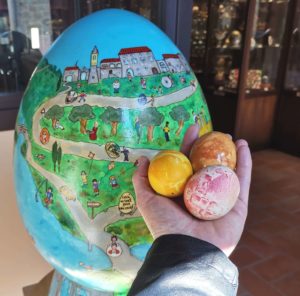
The chemistry is simple and elegant. Boiled spinach yields green; red beetroot gives red; saffron produces yellow. Eggshells are porous and calcareous, so they absorb the vegetable pigments quickly, with a beautiful and surprisingly intense result.
Is this tradition still alive in Italian families today?
Absolutely. We still do it every year — the only difference is that today the boiled eggs are served as an antipasto for Easter lunch, rather than for breakfast. In the past, families fasted from Good Friday onwards, which is why the eggs were eaten on Easter morning together with pizza salata al formaggio (a traditional cheese-enriched Easter bread) and capocollo cured pork. Few families fast that strictly anymore — and honestly, I couldn’t eat all that for breakfast even if I tried.
What exactly is the Ovo Pinto competition?
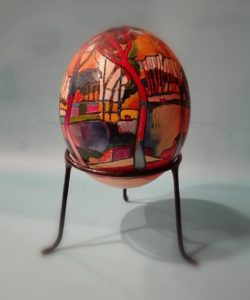
It’s a national artistic competition, founded in 1982, that awards the most beautiful painted eggs of the year. The association created it to valorize the ancient tradition of egg-decorating, and at first the contest was open only to schools. As it grew in popularity, we opened it to everyone — and now we receive entries from students, amateurs, and professional artists across Italy and from abroad.
How has the competition evolved since the first editions?
In the early years, the eggs arrived full. That meant that after a few days they released a rather unpleasant smell, and the committee had to throw them out. To preserve them — partly for historical reasons, partly because the works were getting too beautiful to lose — we asked participants to either empty the eggs first or extract the contents.
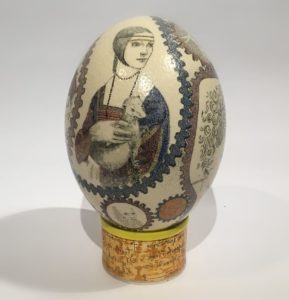
Today we ask everyone to empty the egg using a small pinhole at each end. For ostrich eggs — yes, over the years we’ve expanded beyond hen’s eggs to ostrich, goose, quail, and more — a fine drill bit is needed. This way we preserve every single egg that’s submitted to us, year after year.
How does the competition work?
The association defines an annual theme — past themes have included Dante, Surrealism, Cinema, and the Voyage. Participants are divided into three categories: students, amateurs, and artists. They send us their painted egg, or hand-deliver it.
The competition opens many months before Easter — often the previous September — and closes a month before Easter Sunday. The exhibition runs from Easter Day through May 1st, when a jury of four external experts plus one association board member announces the winners.
And you keep them all?
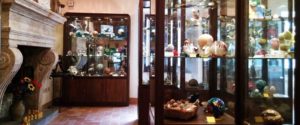
Yes, all of them. The competition rules state that entries become the permanent property of the association once submitted. Initially conservation was a problem — we stored eggs in different locations around the village. That’s exactly why in 2005 we opened the museum, and each year we rotate the display so the full collection eventually gets seen by the public.
Even now, after twenty years of collecting, conservation remains a creative challenge. But we have many partnerships, and our eggs travel often, lent to other cultural sites for special exhibitions.
When can visitors come to the museum?
The Museo dell’Ovo Pinto is open year-round, primarily on weekends. A phone call is enough — I’m five minutes from home and can come open it personally, or someone else from the association will. We prefer visitors call ahead so we can give them proper attention; this isn’t a big city museum where you queue and shuffle through.
Have you ever entered the competition yourself?
I did, in 2007, with an egg on the theme of Surrealism. Seeing it still on display all these years later moves me every time.
What does it mean for you to be active in this tradition?
It’s a source of pride, and a responsibility. Civitella del Lago is the “village of eggs” — and it always must be. I carry this work with pleasure and with the awareness that I’m part of a chain that goes back centuries.
Has anything in recent years really surprised you?
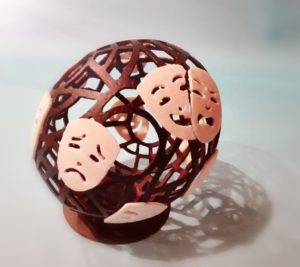
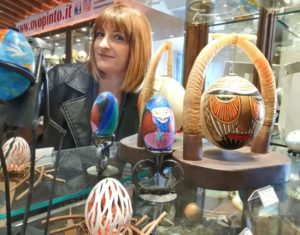
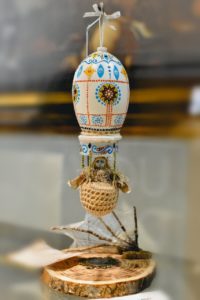
Every year there’s something that leaves us speechless — sometimes for the concept, sometimes for the technique. We receive eggs that are true sculptures, with carvings, mosaics, miniature scenes inside. The creativity is endless, and seeing it firsthand is always emotional.
What’s the most distant place an egg has ever come from?
Mexico. And in recent years we’ve started receiving entries from Russia, Spain, Argentina. The internet has done a lot of work for us — people abroad discover the competition online and decide to participate.
Where to Find Civitella del Lago and the Museum
The Museo dell’Ovo Pinto sits in the ancient medieval center of Civitella del Lago, a hilltop village at 476 metres above sea level that dominates Lake Corbara and the middle Tiber Valley. The village is roughly equidistant — about 20 km — from both Orvieto and Todi, accessible from the SS448 Todi-Baschi state road.
The panorama from Piazza Belvedere, the medieval lookout point inside the old walls, is among the most striking in central Umbria — on a clear day you can see as far as the mountains of Lazio and Tuscany.
The museum is part of the Network of Small Museums of Umbria and Lazio — a circuit of hidden gems off the main tourist routes that reward travelers willing to go slow.
Museo dell’Ovo Pinto
Piazza Giuseppe Mazzini 9, Civitella del Lago (TR), Umbria
www.ovopinto.it
Plan a slow Umbria experience around the Easter season with our Lugnano in Teverina and the Amerini Hills tour or our private cooking lesson in Umbria.
Frequently Asked Questions
What is the Ovo Pinto?
The Ovo Pinto (literally “painted egg” in the local dialect) is a national art competition held every Easter since 1982 in Civitella del Lago, Umbria. Artists from Italy and abroad submit hand-painted, decorated, or sculpted eggs — from hen’s eggs to ostrich — and the works become part of the permanent collection of the Museo dell’Ovo Pinto.
When can I visit the Museo dell’Ovo Pinto?
The museum is open year-round, primarily on weekends, by appointment. Call ahead and a member of the Ovo Pinto Association will personally open the museum for you. The annual exhibition of new entries runs from Easter Sunday through May 1st.
How are eggs naturally dyed for Easter in Italian tradition?
Traditional Italian Easter eggs are dyed by boiling them together with vegetable matter: spinach for green, red beetroot for red, saffron for yellow, onion skins for orange-brown. The porous calcareous shell absorbs the pigments naturally, with no chemicals required.
Where is Civitella del Lago?
Civitella del Lago is a medieval hilltop village in Umbria, central Italy, in the province of Terni. It sits at 476m above sea level overlooking Lake Corbara and the Tiber Valley, roughly halfway between Orvieto and Todi (~20 km from each).
What are the traditional Easter foods in Italian villages?
Traditional Italian village Easter foods vary by region, but a common pattern includes hard-boiled eggs blessed by the priest, pizza salata al formaggio (cheese-enriched Easter bread), capocollo cured pork, and a sweet bread or cake — in Umbria often torta di Pasqua. The eggs were historically eaten on Easter morning to break the Holy Week fast; today they more often appear as antipasto at Easter lunch.
Interview with Barbara Bilancioni, President of the Ovo Pinto Cultural Association of Civitella del Lago.